T-Mobile Direct Connect
- 1.09K
- 4.8
- Installs
- 870.00M
- Version
- Varies with device

Screenshots


Introduction: A Direct Line for the Digital Age
In an era dominated by messaging apps and social media, the need for instant, reliable, and clear voice communication remains critical, especially for teams, families, and outdoor enthusiasts. Enter the T-Mobile Direct Connect app, which brings the power of push-to-talk (PTT) technology to modern smartphones. This app aims to replicate the immediacy of a walkie-talkie over the expansive reach of T-Mobile's nationwide network, promising a seamless communication tool that works wherever your cellular data or Wi-Fi connection does. But does it deliver on this promise? This review dives into its features, performance, and ideal use cases.
Core Functionality & Key Features
The T-Mobile Direct Connect app transforms your iOS or Android device into a powerful digital two-way radio. With a simple tap of the on-screen button, you can broadcast your voice to an individual contact or an entire group instantly. Unlike traditional radios limited by line-of-sight and range, this app leverages T-Mobile's LTE/5G network and Wi-Fi, enabling nationwide communication. Key features include one-to-one and one-to-many calling, group creation for team coordination, and contact lists that sync across your devices. A standout function is the "Talker Alias," which verbally announces who is speaking—a major advantage in group chats with multiple participants.
Performance & Call Quality
Performance is where the app's network dependency becomes its greatest strength and potential weakness. When on a strong T-Mobile LTE/5G or Wi-Fi signal, connection times are impressively fast, with minimal latency—often under a second. Call clarity is typically superior to analog walkie-talkies, with digital audio that is crisp and clear. However, in areas with poor cellular reception, users may experience delays or failed transmissions. It's crucial to understand that this is not a replacement for mission-critical LMR (Land Mobile Radio) systems but is an excellent supplement for general business coordination, event management, or keeping in touch with family during trips.
User Experience & Interface
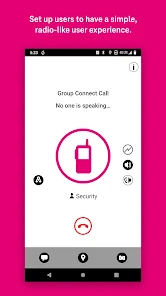
The app boasts a clean, intuitive interface designed for quick, one-handed operation. The large, prominent push-to-talk button is easy to locate and use. Managing contacts and groups is straightforward, and the notification system effectively alerts you to incoming calls. The app integrates with your phone's existing contacts, simplifying setup. Some users might find the need for a specific T-Mobile Direct Connect plan a hurdle, as it is not included in all standard rate plans. Furthermore, while the app itself is free to download, functionality requires this dedicated service add-on from T-Mobile.
Competitiveness & Unique Value Proposition
The push-to-talk app market includes competitors like Zello and traditional carrier offerings. T-Mobile Direct Connect's primary advantage is its deep network integration, which can offer prioritized data for PTT traffic, potentially improving reliability during congestion. Its seamless operation over both cellular and Wi-Fi provides flexibility that standalone Bluetooth walkie-talkies cannot match. For existing T-Mobile customers, especially those on business plans, it presents a consolidated and cost-effective communication solution, eliminating the need for separate radio hardware and its associated licensing and maintenance.
Conclusion: Who Is It For?
The T-Mobile Direct Connect app is a robust and capable digital PTT solution that successfully bridges the gap between traditional two-way radios and smartphone convenience. It is ideally suited for small business teams, retail staff, security personnel, event organizers, and families who need instant, wide-area voice communication without investing in dedicated radio infrastructure. Its performance is inherently tied to T-Mobile's network coverage, so it is most powerful for existing customers within strong service areas. If you're looking for a modern, network-powered "walkie-talkie" experience that leverages the device already in your pocket, T-Mobile Direct Connect is a compelling and efficient choice worth exploring.


